Our vision is vision.
A navigation companion for blind Australians — helping you move through the world
ChatLemur is an extensible life platform, powered by a real-time AI vision system — built blind-first because accessibility done right is better for everyone. At its core is an on-device vision companion that sees and describes what’s around you and, in development, helps you get from A to B with careful, honest awareness of the path ahead. It assists everything and replaces nothing. Your cane and guide dog stay primary.
In development — not yet available
- Perception engine built & unit-tested
- One internal & one external adversarial safety review
- Blind founder — national-scale AU gov & finance, RBA >$1B
- Honest about every gap — no over-promise
- Approach validated in published accessibility research (CHI 2026)
“The navigation layer that lets a blind person take a bus alone for the first time.”
Perception layer: built and unit-tested on iPhone today. Navigation layer: designed and in development — this is the stage your funding unlocks.
The problem
Blind and low-vision Australians have excellent tools for getting around — the long cane, the guide dog, and Orientation & Mobility (O&M) training. Around those tools there is a persistent, unfilled gap.
Today’s AI vision apps answer “what’s in this photo?” — a static frame held at arm’s length. Almost none help with the moving problem: walking somewhere, tracking the ground ahead, warning about a step or a kerb edge as you move.
The dedicated devices that do help with movement cost roughly A$1,500–A$11,800 — out of reach for most people. There are roughly 575,000 blind or low-vision Australians (Vision Australia 2024 — figure will be re-verified before each external use), and a guide dog reaches only a small fraction. The single most consequential daily task — getting from A to B on foot — is the least well served by technology.
Our thesis: the iPhone most blind people already carry can do far more than it does today. Reach and affordability are the whole game, and “no extra hardware required” is a structural advantage no A$10k device can match.
What we’re building — and where we are honestly
Working today in the development build
- Reads any sign or document aloud
- Names objects on demand
- Recognises consent-enrolled faces
- Finds named objects (earcon sweep)
- Answers questions about the scene
- Remembers what you passed
Backed by a growing automated test suite — 700+ checks and climbing as of July 2026. All items above are verifiable in a live demo to any interested funder or partner. Development build
The central rule, stated first:
It assists everything and replaces nothing. The cane and the guide dog stay primary. The user’s judgment is always the authority. This system is deliberately built never to say “it’s safe to cross” — and it steps back whenever it’s unsure. We’d rather ship a smaller honest tool than a bigger one that over-promises.
The companion is an on-device iPhone app that sees and describes (scenes, text, objects, colours, familiar faces) and, in development, helps you get from A to B with careful awareness of the path in front of you.
Built and tested today — available in the current build
Real-time perception: scene description, OCR, object and face recognition, obstacle awareness, depth zones, earcons, haptics and a hedged-speech engine that never over-claims sensor confidence. This layer works on iPhone today.
Designed, in development — not yet available
Street-level navigation fused with micro path-and-edge awareness; a runtime safety layer that must clear every sensor check before it may guide; walkable-path detection; pedestrian crossing awareness. Validated in stages with mobility specialists before anyone walks with it.
Honest about what isn’t done — acknowledged gaps
Zero deployed users. No field validation yet. Three known pre-walk issues to fix before any blind person walks with the navigation layer. The perception core is unit-tested, not field-validated. We say this plainly because honesty is the differentiator a blind-community funder trusts.
Where it’s going — future vision
Smart glasses (Meta Ray-Ban, Apple glasses) are a possible future interface — camera as your eyes, hands-free, on your face. An optional haptic wearable could add a tactile channel. The phone stays primary; accessories are exploratory, not yet in development.
How we build — safety discipline, not shortcuts
For a blind-navigation tool, how you build is as important as what you build. The rules below apply right now, in the development build — not later, when people are walking.
- One internal and one external adversarial safety review, completed before any blind person walked with the navigation layer. Both examined the real built code, not a spec. Both surfaced genuine blocking issues — finding them on the bench, not on a footpath, is the process working.
- Staged validation under O&M supervision, with HREC ethics approval, before any unsupervised solo use. The sequence is fixed: closed course with a mobility specialist first; public footpaths only after pre-registered safety metrics are met and signed off.
- A device-free automated test harness. Perception behaviour is codified in a growing automated test suite (700+ checks as of July 2026). Tests run without a phone attached — so the safety specification is machine-verified, not reliant on a human remembering to check it.
- Hedged-speech design, by engineering. The system is built never to over-claim sensor confidence. Every spoken cue hedges uncertainty by design — the language engine is engineered to step back when it is unsure, so a user is never misled about what the system can and cannot see.
These governance choices were made before any funding was secured, and before any blind person walked with the system. They are not compliance theatre — they are the minimum bar a system you walk behind must clear.
Grant committees and impact funders tell us that safety discipline is the biggest de-risker in this space. Our process is designed to be inspectable: milestone-released funding, written quarterly reports, and a technical partner review option on request.
Why we believe it’s real
- A working, tested perception engine — not a pitch deck. The real-time perception core is built in Swift and passes its automated unit-test suite. This is meaningful evidence that the project is genuine engineering at MVP stage, not a concept.
- Adversarial safety reviews completed before any field walk. One internal and one external review — both examined the real built code and both surfaced genuine blocking issues. Detail in the ‘How we build’ section above.
- Grounded in the guide-dog training curriculum. We mapped trained guide-dog behaviours against what the app does and where it falls short, and modelled intelligent disobedience — the trained refusal to follow a command into danger. Assist, never lead blindly.
- Blind-founded, with real Australian engineering pedigree. The founder, Joe Webber, is a blind developer with 16+ years of production delivery across government, finance and payments — including a Reserve Bank of Australia integration that processed over $1 billion and the accessibility-mandated National Redress Scheme survivor portal. The person setting the safety rules is the person who will walk behind them. LinkedIn →
- The approach is validated in published accessibility research. Real-time street-level AI description for blind navigation has been demonstrated in peer-reviewed accessibility research (CHI 2026). We are building on an approach that the research community has independently validated — not a theoretical concept.
We are honest about where we are behind: several competitors ship dedicated hardware today, no field validation has occurred, and the primary object-detection model is not yet bundled. Our thesis is that radical honesty, in a space full of over-promising, is the differentiator a guide-dog-world funder trusts — and that this idea-lead becomes a validated-product lead only with the validation capital this ask funds.
The honest competitive position: Dedicated devices that help blind people with movement exist and ship today — at roughly A$1,500–A$11,800. Nobody ships this as software on the phone a blind person already owns, without extra hardware. Converting that open niche into a validated, affordable product for 575,000 Australians is exactly what this funding buys.
A look inside the app
Development build — real screens, not mockups
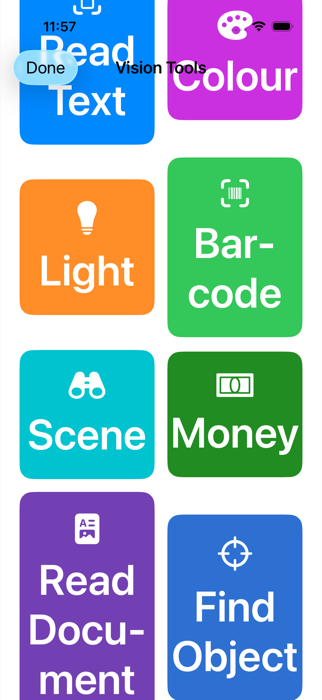
Vision Tools — reading text, describing scenes, finding objects (development build).
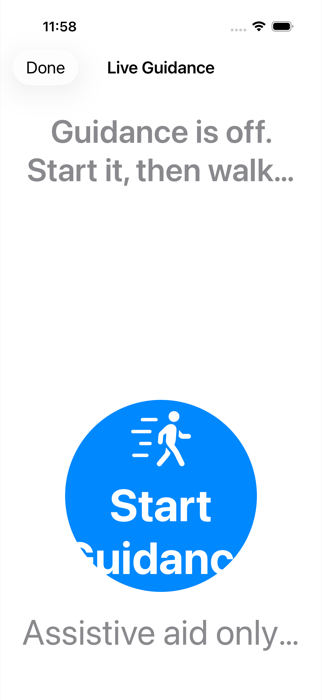
Live Guidance — the walking-assist companion. Assistive aid only; in development.
These are early development-build screens. The perception layer is built and tested; the navigation layer is in development.
Why it matters — the impact case
Reach and affordability are the whole game. A guide dog reaches fewer than roughly 10,000 handlers nationally, against ∼575,000 blind or low-vision Australians. Dedicated mobility hardware costs A$1,500–A$11,800. Our companion runs on the iPhone the person already owns. For a mission-driven funder trying to reach the large majority a guide dog never reaches, this is the difference between a niche device and genuine accessibility.
An Australian-owned, public-good asset. The ambition is not just a product — it’s an Australian dataset and capability for blind navigation: validated locally in Adelaide, then Australia-wide, built for our footpaths, our crossings and our conditions. A durable public good, not a foreign-owned black box.
Community-owned, co-designed, safety-first. The goal is to build this with the blind and low-vision community, with O&M specialists setting the validation bar, and with blind organisations as partners — not customers. Our longer-term vision is a mixed community — sighted and blind people together, in the spirit of Be My Eyes — where the platform’s accessibility strengths benefit everyone.
The ask — what funding does
Funding does three things: (1) keep the founder building full-time, (2) buy the safety validation that can’t be done solo, and (3) complete and ship the designed layers.
First / urgent
~A$25k–A$40k
Keep-building tranche — 3–6 months. Founder living, test hardware, compute & hosting. Unblocks everything.
Full build + validate
~A$80k–A$120k
12-month mid-case. O&M validation, ethics/HREC, Adelaide data capture, audit & legal. Milestone-based, tranche-released.
First, urgent — the “keep-building” tranche (~A$25k–A$40k, 3–6 months): covers founder living and tools, test hardware (LiDAR + non-LiDAR iPhones), AI compute and hosting. This is the size an accelerator seed, a small philanthropic grant, or an auspice-partner arrangement can deliver fastest — and it unblocks everything else.
Full 12-month build + validate (~A$80k–A$120k mid-case): adds O&M validation sessions, ethics/HREC, participant support, Adelaide data capture and labelling, cloud GPU training, accessibility audit and legal/compliance. In-kind O&M and device support from blind-organisation partners can materially reduce the cash figure.
All figures are illustrative ranges — real numbers are set with Joe before any application. We propose milestone-based, tranche-released funding, so money is released against demonstrated, inspectable progress. We welcome co-design, shared-IP arrangements for the public dataset, and in-kind support in place of or alongside cash.
We do not publish detailed line-item budgets on this page — those go in the pitch pack shared in conversation, so you can see the exact numbers with context. This page shows what the money does; the pitch pack shows the numbers.
What your funding produces — and how you’d verify it
We propose milestone-released funding: money moves only when the previous proof-point is inspectable. The table below shows what each funded stage produces and how a funder or partner can verify progress.
| Funded by | Milestone | Proof you can inspect |
|---|---|---|
| Keep-building tranche ~A$25k–40k |
Navigation and safety layer complete — all designed features coded and passing automated tests | Code shipped against written specs; test suite green. Inspectable in the repository by any technical partner on request. |
| Full build tranche ~A$80k–120k |
Staged validation with an O&M specialist on a closed course | Quantitative acceptance metrics met; O&M specialist sign-off. No public footpath use before this milestone clears. |
| Full build tranche | Ethics/HREC approval and participant-support framework in place | Formal HREC approval documentation. Shared with funders and co-design partners before any participant work begins. |
| Full build tranche | Adelaide data capture and labelling complete | Captured dataset with Australian-conditions coverage (footpaths, crossings, signage). Summary statistics shared with funder; raw data available to partner organisations on agreed terms. |
| Full build tranche Vision milestone |
Door-to-door journey assistance — public transport as part of the route (finding the stop, boarding cues, knowing when to get off) integrated with the walking and venue-wayfinding layers | Design document + O&M specialist review of the public-transport module before any real-world trial. No unsupervised use before staged validation on a closed route with a mobility specialist. |
| Both tranches | Ongoing: quarterly written progress report to each funder | Written report — what shipped, what is blocked, what comes next. No funder is left wondering what happened to their money. |
All figures are illustrative ranges. Detailed line-item budgets, pre-registered metric values and exact acceptance criteria go in the pitch pack shared in direct conversation — not on this public page (disclosure discipline). The structure above reflects the real milestone sequence; the numbers are illustrative until agreed with Joe before any application.
How to partner, support or advocate
We want partners, not just funders. There are four honest ways to help:
Fund
Grants, philanthropic gifts, accelerators, or direct investment. Tranche-based, milestone-released. Disability-tech accelerators, big-tech accessibility grant programs, and AU government and philanthropic disability streams are the primary targets.
Advocate
Blind organisations and peak bodies, lived-experience reviewers, O&M specialists. We need the community’s voice in design, not just at the end. If you represent a blind organisation, a community group, or have lived experience to share, please reach out.
Partner
O&M / mobility specialists, researchers, universities and disability-research institutes, blind organisations willing to co-design and validate. In-kind time, access to specialist expertise and ethics support are as valuable as cash at this stage.
Pilot host
Host a supervised closed-course or public-footpath trial. All pilots are O&M-supervised, staged (closed course before public footpaths), and ethics-reviewed. No blind person walks with the navigation layer unsupervised until pre-registered safety metrics are met.
Who we’re looking for — you’re in the right place if you are:
- A grant body or philanthropic funder — milestone-released funding; we send you a pitch pack with line-item budget and safety-review summaries on request.
- A blind organisation or peak body — co-design input, lived-experience review, advocacy, or auspice-partner arrangements are all welcome.
- An O&M or research partner — validation partnership, university or research-institute collaboration, or ethics/HREC co-design.
- A pilot host — closed-course or supervised public-footpath trial; all pilots O&M-supervised and ethics-reviewed.
- An accessibility-grant program (e.g. big-tech accessibility funds, AU government disability-tech streams) — we can tailor the pitch pack to your grant format on request.
Start a conversation
If you’re interested in funding, advocating, partnering or hosting a pilot, use the form below — it’s the fastest path to the pitch pack, a call, or a live demo. We aim to reply within two business days. You can also email directly: joseph.webber@me.com.
Email for the pitch pack (pre-filled) →
When you reach out, we send you: a pitch pack covering the milestone plan, a line-item budget, and the safety-review summaries — plus a standing invitation for a live demo of the current development build. You see the real numbers, not just the ranges on this page. Just say in your message whether you’d like the pitch pack, a call, or a live demo (or all three) and we’ll get it to you.
Request the pitch pack or start a conversation
Tell us who you are and how you’d like to help — or what you’d like next (pitch pack, a call, or a live demo). We aim to respond within a few business days.
Status reminder: the vision and navigation companion described on this page is in development and not yet available for download or use. It is not a licensed mobility aid, and it does not replace a cane, a guide dog or professional O&M training. Nothing on this page is a commercial offer, warranty or performance guarantee. The perception layer (seeing and describing) is built and tested; the navigation layer is designed and in development. No blind person will walk with the navigation layer unsupervised until pre-registered safety metrics are met under O&M supervision.
All capability claims are subject to ongoing review before any external use. Figures marked illustrative are to be verified and set before each application.